

Sandia Cave, located on the steep wall of Las Huertas Canyon in the northern Sandia Mountains near the Village of Placitas and just northeast of Albuquerque, sits high above the valley. The cave is accessible via a challenging trail, about a half-mile long, off New Mexico State Road 165, followed by a narrow ledge and a metal spiral staircase to reach the entrance. Despite the demanding approach, visitors who make the journey stand in a space that has captured scholarly attention for nearly a century.
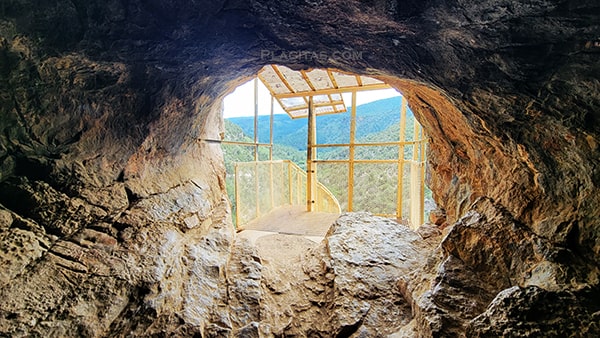
First brought to scholarly attention in the mid-1930s, excavations, led by archaeologist Frank Hibben, unearthed stone tools and bones of extinct Pleistocene animals such as mammoths, mastodons, camels, sloths, and early horses. From this, Hibben proposed the existence of a “Sandia culture,” suggesting human presence thousands of years before well-known groups like the Folsom people. The initial interpretation offered a provocative new chapter in North American prehistory, implying deeper human roots across the continent.
Over time, many in the archaeological community questioned these early claims. Critics pointed to potential mixing of archaeological layers, possibly due to animal burrowing, and inconsistencies in the physical evidence. Some even suggested that certain artifacts may have been purposely planted to support the narrative of “Sandia Man.” These concerns were magnified by investigative reporting, most notably in The New Yorker, which questioned the authenticity of the findings. Over subsequent decades, through deeper study of stratigraphy, radiometric dating, and further site analysis, the consensus shifted. The concept of a pre-Folsom “Sandia culture” is no longer accepted in professional archaeology, and the site’s earlier interpretations are widely regarded as unreliable.
Though the archaeological claims are largely discredited, Sandia Cave remains listed on the National Register of Historic Places and was designated a National Historic Landmark in 1961. Importantly, its story continues to be part of archaeology coursework, not as an example of early American prehistory, but as a case study in critical thinking and scientific scrutiny.
Visiting Sandia Cave today offers more than physical adventure, it invites visitors to reflect on how knowledge evolves. As you navigate the trail and climb the staircase, you’re walking through a site that reminds us of the importance of disciplined inquiry. Please keep in mind that the cave is protected both as a historic site and a cultural landscape. Visitors are urged to respect the space: no fires, no graffiti, and all trash packed out. Maintaining care ensures that Sandia Cave remains an educational resource for all who wish to connect, mindfully and responsibly, with layers of our shared past.
From the Village of Placitas, head east on NM-165 into the Sandia Mountains. Continue on this winding road for roughly 10 miles until you reach a small parking area on the left side, marked with a sign for Sandia Cave. From the parking area, the trail is about a half-mile hike to the cave entrance, followed by a short climb up a metal spiral staircase that leads directly into the cave.